And Yet, There is Still Light
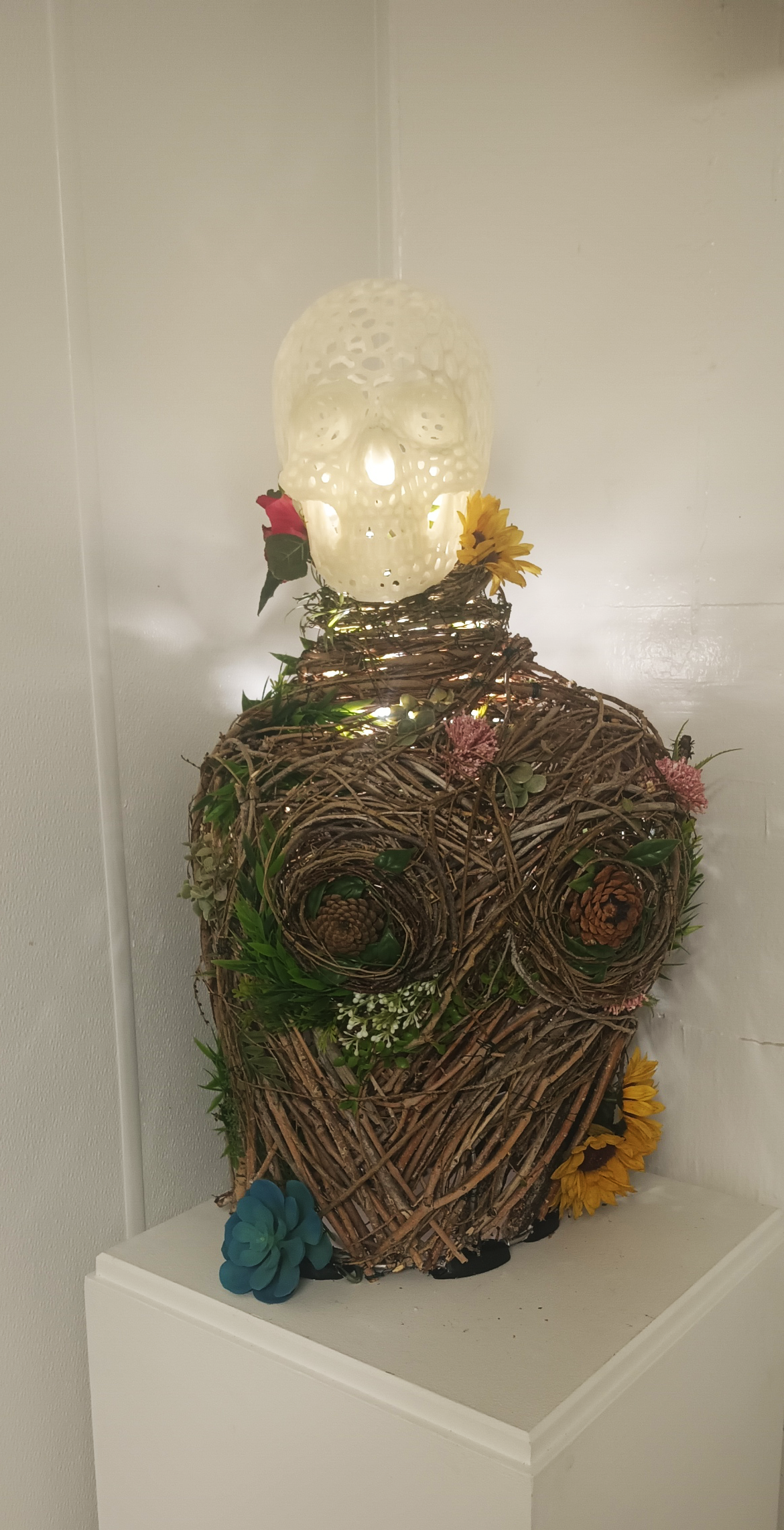
And Yet, There is Still Light began as an attempt to give physical form to something difficult to see: The experience of struggling with brain health while knowing that somewhere beneath the confusion and loss, the soul persists.
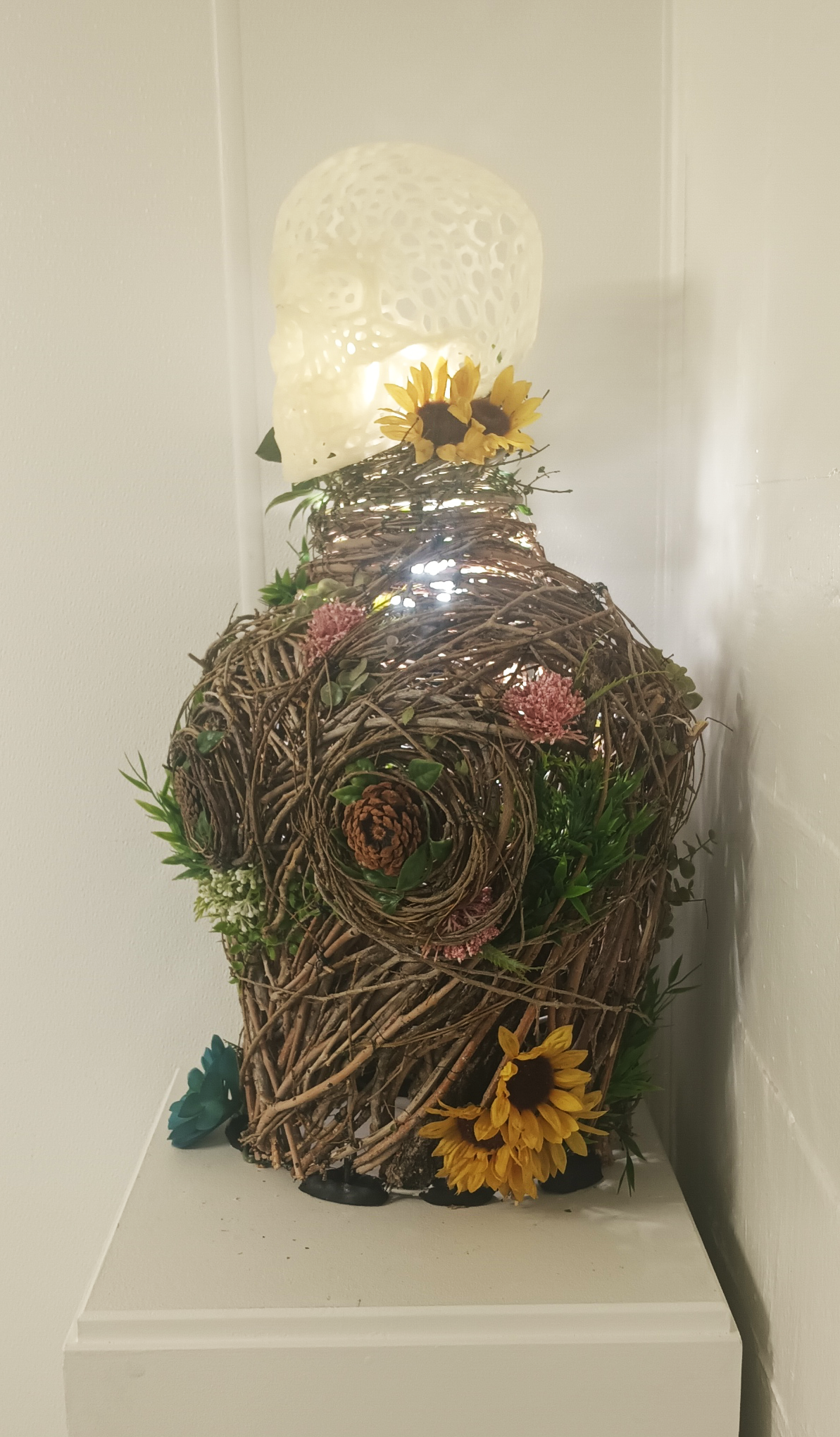
I began with sticks.
They were meant to represent the chaos of life–the way it twists, turns, crosses over itself, breaks apart, and somehow continues…but collecting them became something more. I spent more time gathering than I ever expected, and somewhere within that repetitive act, the process became meditative. As I walked, searched and collected, I found myself reflecting on my health, my life, and the uncertainty of both. The gathering became as important as the building itself. Each branch carried time with it.
Constructing the figure required the same kind of surrender. The tedious work forced my attention toward what was directly in front of me rather than toward what the finished product was supposed to become. Trusting that process does not come naturally to me. There is comfort in knowing the destination, but creation often asks us to continue without one. When I allow my hands to work and my mind to quiet–to put on music, let my body take over, and simply make–the work has a way of revealing itself.
This piece did exactly that.
Without intending it, the branches began to resemble a nervous system: tangled pathways reaching, intersecting and communicating. Themes that continually return throughout my work found their way in as well–life and death, trees and the human figure, grief, health, geometry, color, light and shadow. They seemed to weave themselves into the sculpture as naturally as the branches were woven into a body figure.
At its center is the skull.
The skull has become a recurring symbol in my work, perhaps because it holds a contradiction I continually return to: the feeling of being close to death while still very much alive. There is a particular kind of grief that can accompany illness–the grief of the self. It is the quiet mourning of abilities, experiences, and versions of oneself that once felt permanent. The body changes. The mind changes. Things once done without thought can become difficult, distant or impossible.
There is no funeral for these losses.
…and yet, they are mourned.
Life is fleeting, and parts of who we believed ourselves to be can disappear. The skull holds that mortality for me, but it also holds something else. Its voronoi pattern brings geometry into the contradiction–mathematical and organic at once, structured yet fragmented. Life itself is threaded with pattern, but it is through the openings in that pattern that something unexpected happens.
Light escapes, the skull cannot contain it.
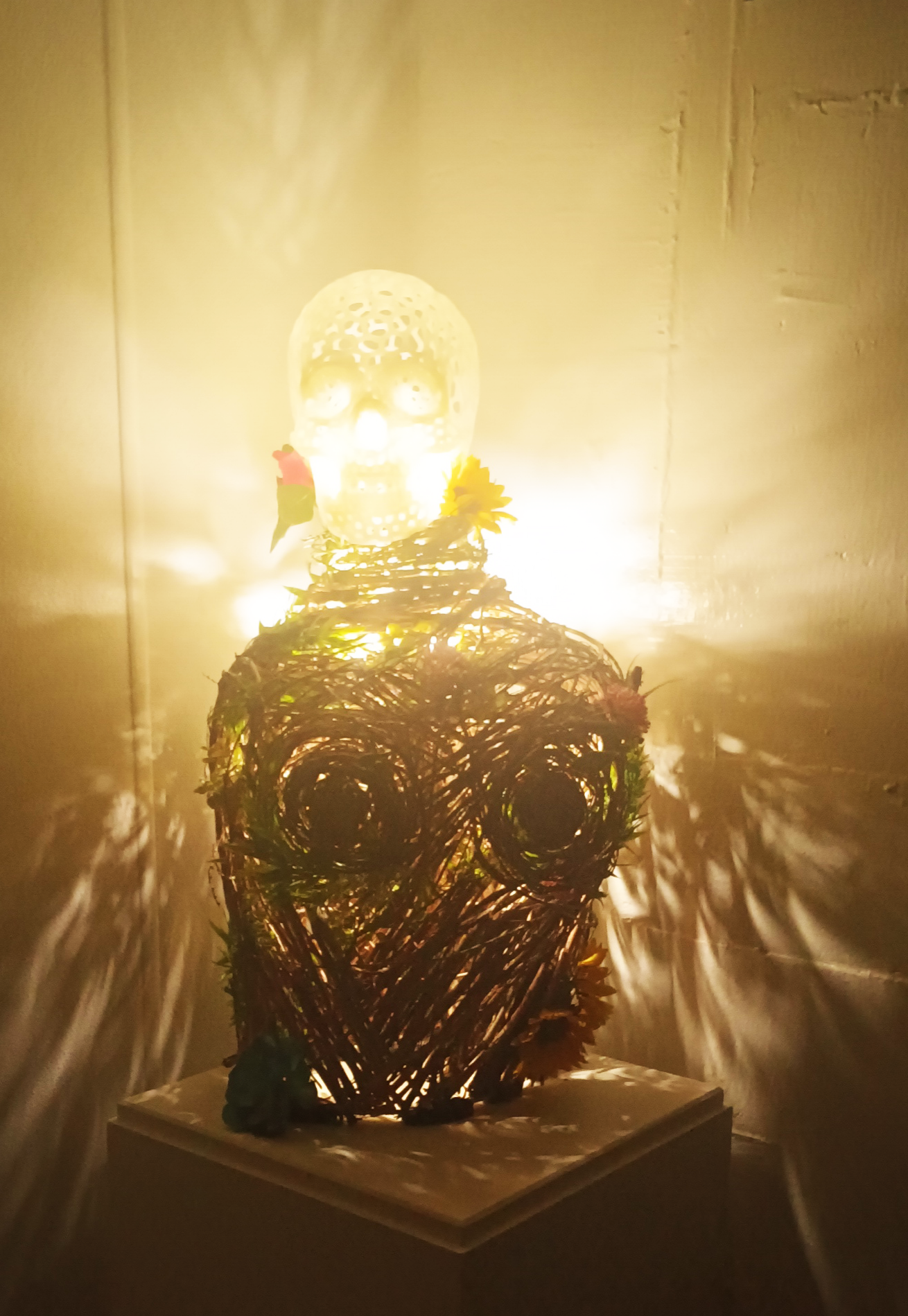
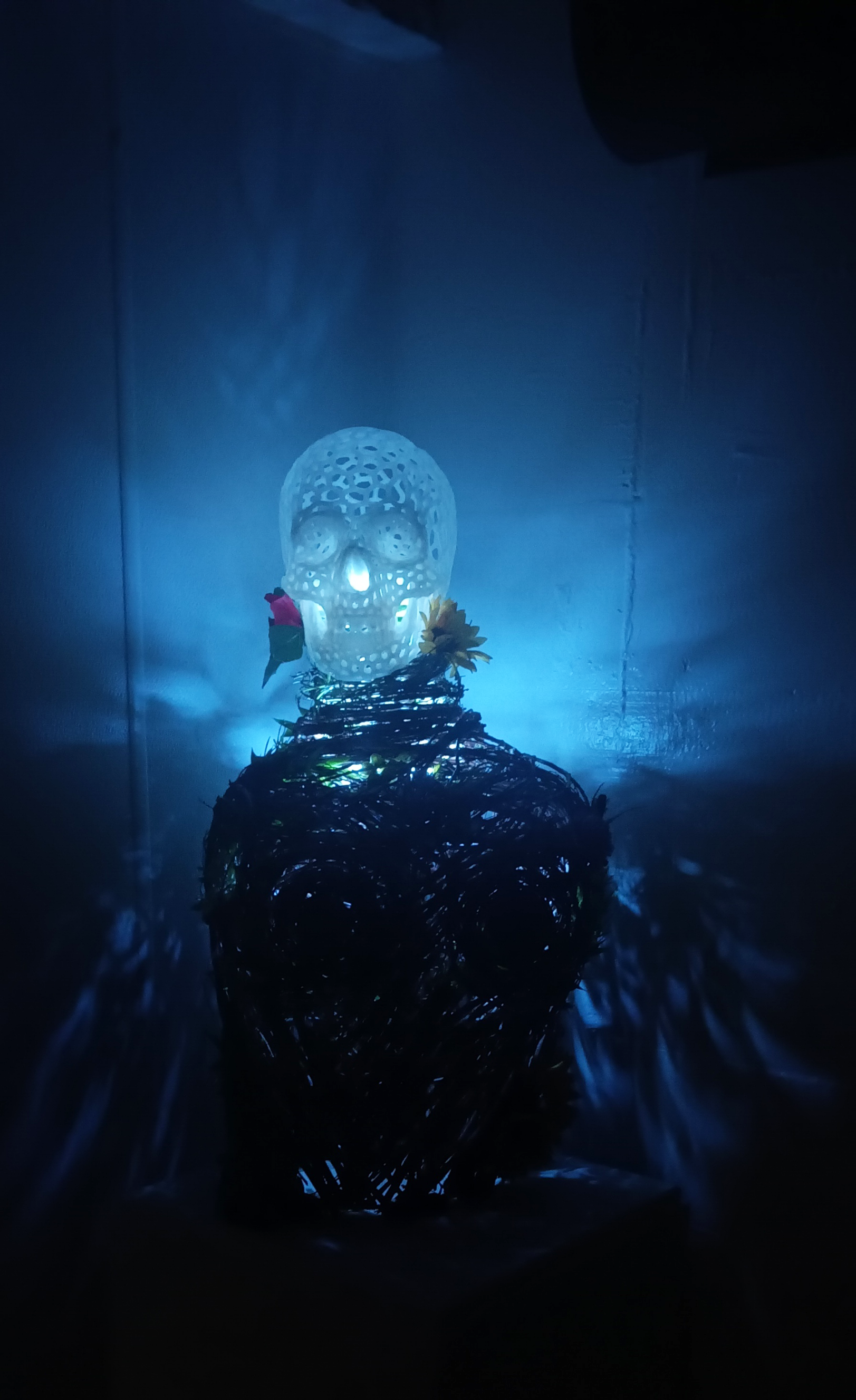
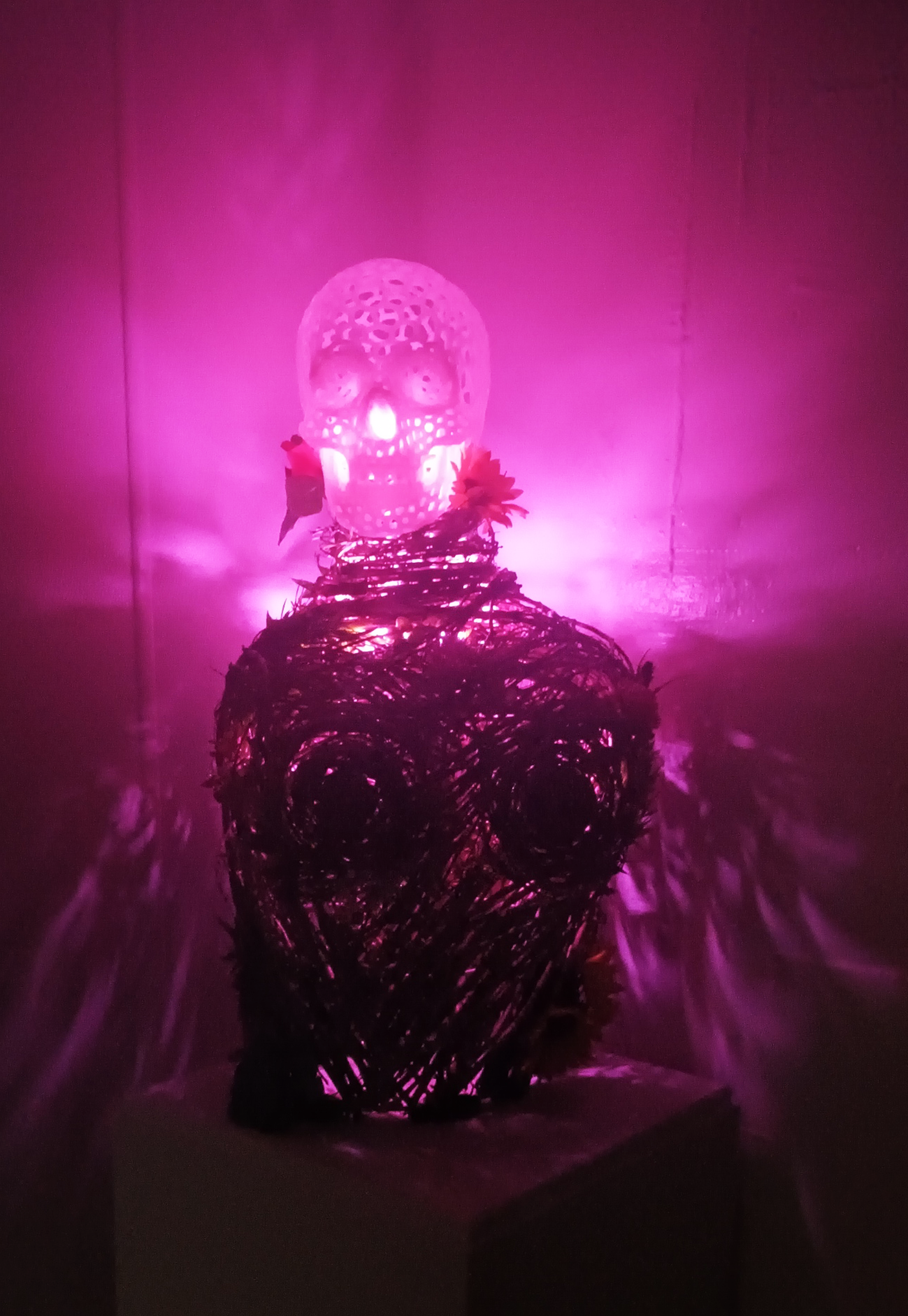
The light within the piece represents the soul–the part that persists even as everything else surrounding it collapses. It passes through every opening and empty space, illuminating the figure and casting itself onto the world around it. Its colors move through the emotional cycle that can accompany illness: blue for depression, red for anger, yellow for joy, and white for overwhelm. These emotions rarely arrive neatly or remain for long. They shift, overlap, disappear, and return. The light changes with them, but it never goes out.
…and where there is light, there is shadow.
The shadows represent another part of that grief–the strange experience of losing pieces of oneself while continuing to exist alongside their absence. Yet when the sculpture was illuminated, something appeared within those shadows that I had never intended to create.
Wings.
I see something protective in them. They remind me of guardian angels, of a presence quietly accompanying us through the things we cannot escape. Their appearance was accidental, but perhaps that is what makes them feel so significant. They emerged from the same light that created the shadows, allowing grief and hope to occupy the same space.
The finished sculpture became something I could not have fully planned. What began as a representation of cognitive struggle became a meditation on uncertainty, grief, creation, mortality, and persistence. In many ways, the process of making it began to mirror the experience it was meant to represent. I built it branch by branch without knowing exactly where it was going, learning to focus on what was directly in front of me and trust that somehow it would become what it needed to become.
…and somehow, it did.
Dead branches form a body. Flowers and greenery emerge among them. A skull, a symbol of death, becomes a vessel for light and life. Darkness casts the shape of wings. The boundaries between life and death, grief and hope, body and soul begin to blur.
The figure is fragile.
It is tangled.
It is changing.
…but it is still standing.
There is loss here. There is chaos, there is grief. There is darkness. None of these things disappear simply because hope exists alongside them.
Perhaps that is what this piece ultimately became for me: not a denial of darkness, but an acknowledgement that darkness and light can coexist.
That even through uncertainty, something persists.
…and yet…there is still light.
Found Sticks, Fake Foliage, and 3D Printed Skull
18 × 36 × 10 inches
2026